
Written by Dr Kavya Chandrashekar, paediatric pulmonologist (children’s lung specialist)
Few things keep parents awake like a child coughing through the night. Coughs are the most common reason children see a doctor, and in the winter months it can feel like one cough rolls straight into the next.
Here’s the reassuring part: most coughs in children are caused by viruses and get better on their own. A cough is actually your child’s body doing its job — clearing mucus and germs out of the airways.
But some coughs do need a doctor, and a few need help urgently. In this guide I’ll explain how to tell the difference: what different coughs sound like, what genuinely helps at home, and the warning signs you should never ignore.
Quick answer: when should I worry about my child’s cough?
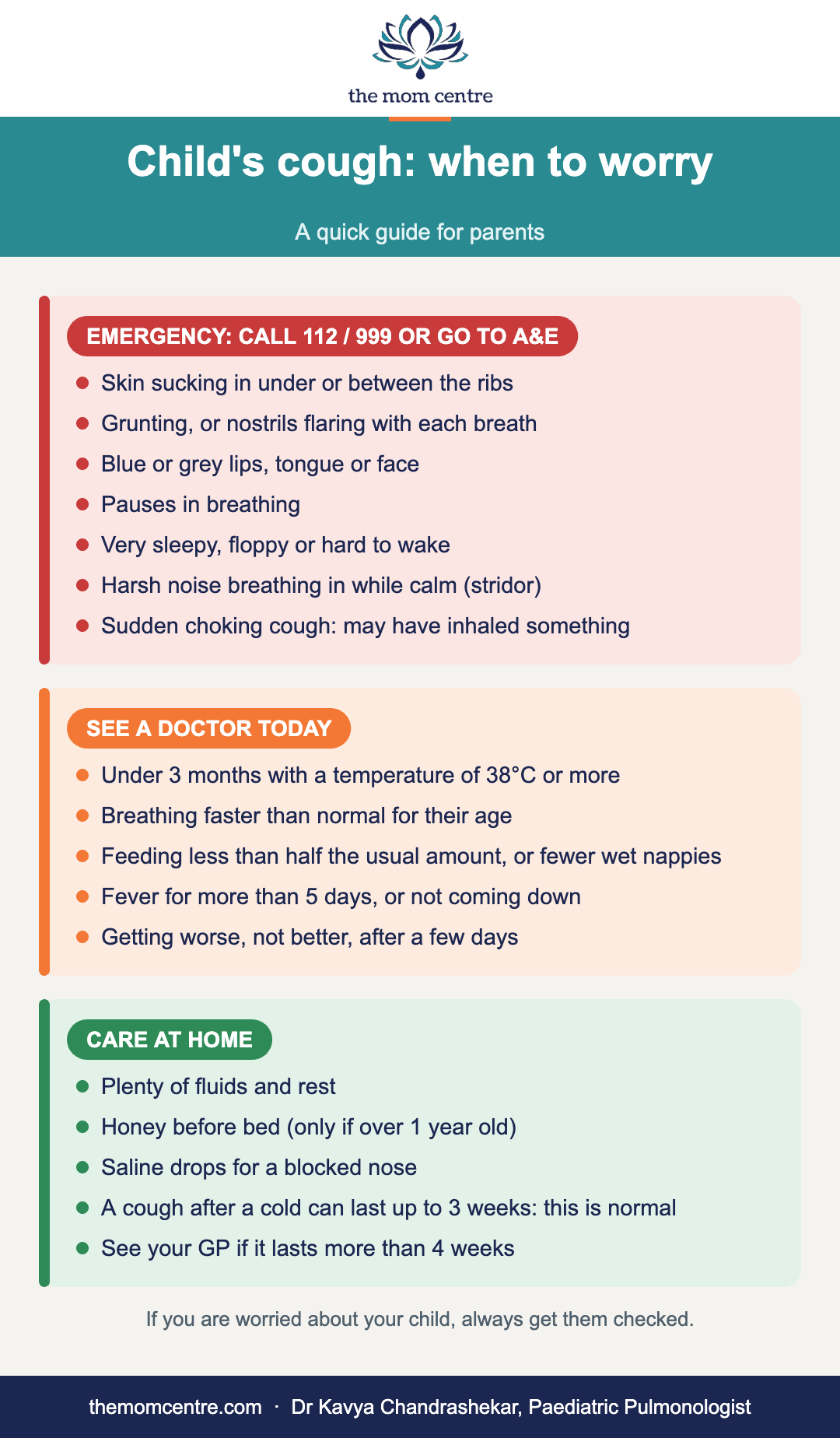
Get urgent medical help (go to the emergency department or call 112 in India / 999 in the UK) if your child:
- is struggling to breathe — you can see the skin sucking in between or under the ribs, or at the base of the neck
- is making a grunting noise with each breath, or their nostrils are flaring
- has blue or grey lips, tongue or face
- has pauses in their breathing, or long coughing fits where they go red or blue
- is very sleepy, floppy or hard to wake
- makes a harsh, high-pitched noise when breathing in while calm (called stridor)
- suddenly started coughing or choking after possibly putting something in their mouth
See a doctor the same day if your child:
- is under 3 months old and has a temperature of 38°C or higher
- is breathing faster than normal (see the table below)
- is feeding less than half their usual amount, or has far fewer wet nappies
- has a high fever that isn’t coming down, or a fever lasting more than 5 days
- has a cough with wheezing, chest pain, or coughing up blood
- seems to be getting worse rather than better after the first few days
Book a routine appointment if the cough has lasted more than 3–4 weeks, or keeps coming back.
How fast is too fast? Normal breathing rates in children
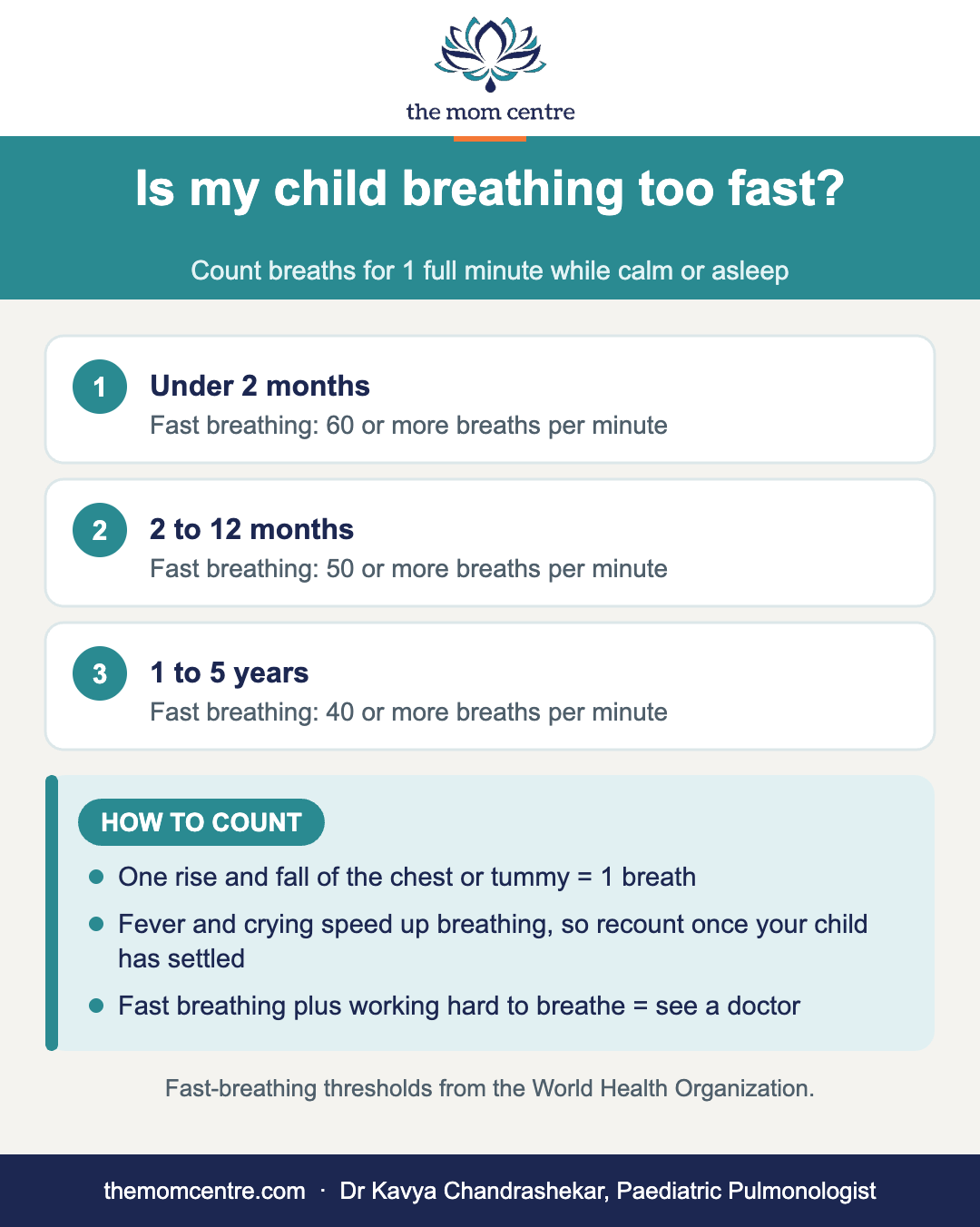
Count your child’s breaths for a full minute while they are calm or asleep (one rise and fall of the chest or tummy = one breath). The World Health Organization uses these cut-offs for fast breathing:
| Age | Fast breathing if |
|---|---|
| Under 2 months | 60 or more breaths per minute |
| 2 to 12 months | 50 or more breaths per minute |
| 1 to 5 years | 40 or more breaths per minute |
Fever and crying both speed up breathing, so recount once your child has settled. If the rate stays high, or you can see them working hard to breathe, get them checked.
What type of cough is it? A guide to cough sounds
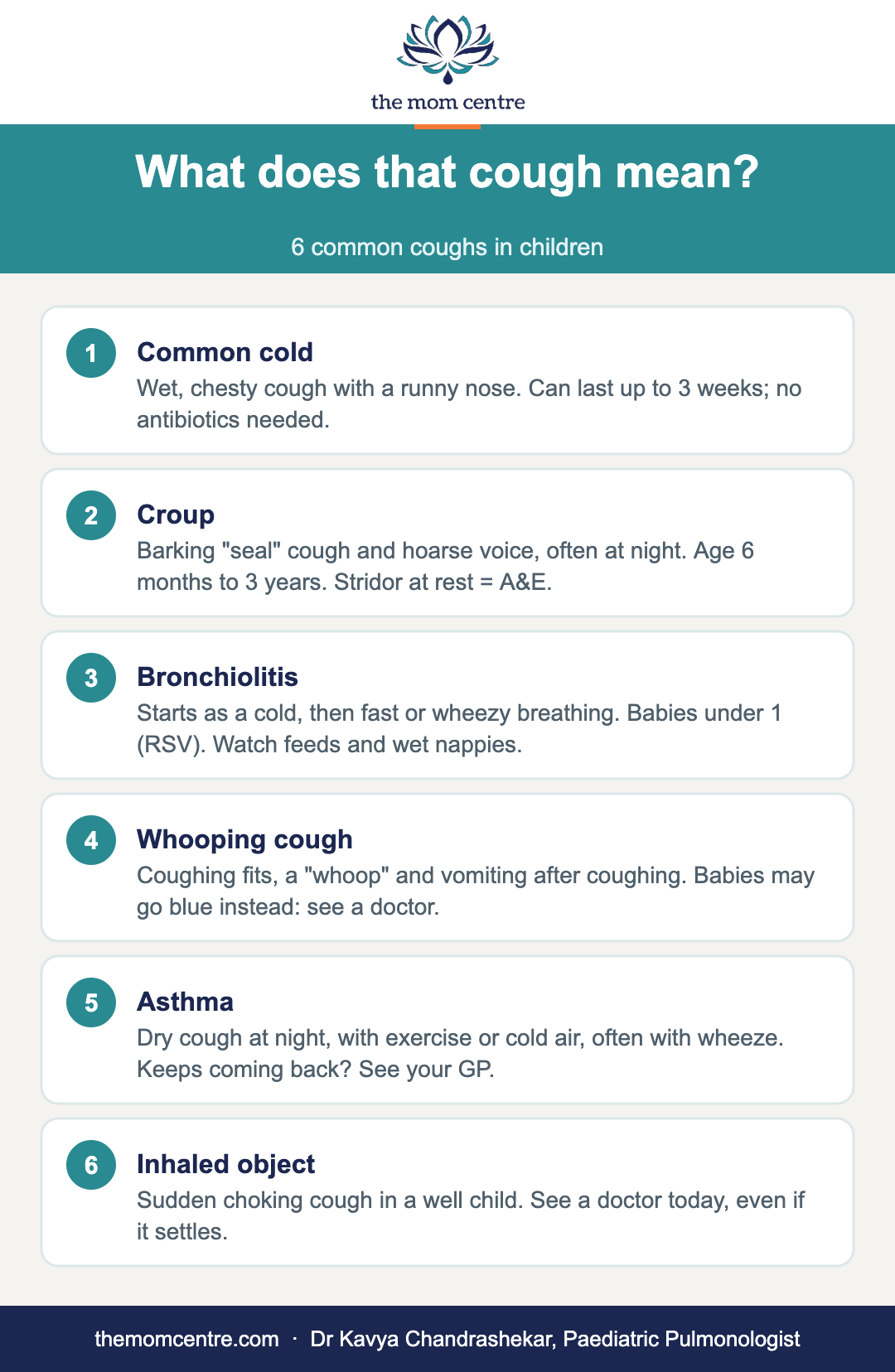
1. The ordinary cold cough
Sounds like: a wet or chesty cough, often with a runny or blocked nose, sometimes a mild fever.
What’s going on: a common cold virus. Mucus from the nose drips down the back of the throat, which is why the cough is often worse when lying down at night and first thing in the morning.
How long: the cold settles in about a week, but the cough can hang around for up to 3 weeks. This is normal and doesn’t mean antibiotics are needed. Young children in nursery or school can catch 6–10 colds a year, so it can feel like they always have a cough.
2. Croup — the “barking seal” cough
Sounds like: a loud, harsh, barking cough, like a seal. Often a hoarse voice. It typically starts suddenly at night.
Who gets it: mostly children between 6 months and 3 years.
What’s going on: a virus causes swelling around the voice box and windpipe.
What to do: keep your child calm and upright — being upset makes croup worse. Most cases are mild and settle in a few days. Your doctor may give a single dose of a steroid medicine, which works very well. Go to hospital straight away if your child has stridor (a harsh noise breathing in) when they are calm, is struggling to breathe, or looks pale, blue or very drowsy.
3. Bronchiolitis — the winter baby cough
Sounds like: starts like a cold, then over 2–3 days develops into a cough with fast or noisy breathing, sometimes a wheeze.
Who gets it: babies under 1 year (and sometimes up to 2), especially in winter. It is most often caused by RSV (respiratory syncytial virus).
What’s going on: the smallest airways in the lungs become inflamed and clogged with mucus.
What to do: most babies can be looked after at home. Offer smaller feeds more often, and use saline nose drops before feeds to clear the nose. It usually gets worse over days 3–5 and then gradually improves; the cough can last 2–4 weeks. Antibiotics, cough medicines and inhalers don’t help bronchiolitis. Seek help if your baby is feeding less than half their usual amount, has fewer wet nappies, is breathing fast, has pauses in breathing, or the skin is sucking in around the ribs. Babies born early, babies under 3 months and babies with heart or lung conditions are at higher risk.
4. Whooping cough (pertussis)
Sounds like: bouts of intense coughing that the child can’t stop, sometimes followed by a “whoop” as they gasp for breath, and often vomiting after coughing. Between fits, the child may seem completely well.
Why it matters: whooping cough can be very dangerous for young babies, who may not whoop at all — instead they may go blue or stop breathing during coughing fits.
What to do: see a doctor promptly. Antibiotics are used, mainly to stop it spreading. The best protection is vaccination — for your child on schedule, and for mothers during pregnancy, which protects the newborn in the first weeks of life.
5. Asthma cough
Sounds like: a dry cough that is worse at night, early morning, with exercise, laughing or crying, or in cold air. Often with wheezing or breathlessness.
Clues: the cough keeps coming back, other family members have asthma, eczema or hay fever, or it is triggered by colds, dust, smoke or pets.
What to do: see your doctor. A cough on its own, without wheeze, is not usually asthma — but a pattern of night-time coughing and wheezing is worth assessing.
6. Sudden cough or choking — an inhaled object
Sounds like: a cough that starts suddenly, often with choking or gagging, in a child who was well a moment ago — classically while eating or playing with small toys.
Why it matters: small objects like peanuts, seeds, grapes, popcorn or toy parts can go down into the lungs. The cough may then settle and seem to go away, but the object can cause pneumonia or a cough that won’t clear weeks later.
What to do: if your child is choking and can’t breathe, cough or cry, start first aid and call for emergency help. If they recover but you suspect they inhaled something, see a doctor the same day, even if they now seem fine.
7. A cough that won’t go away (chronic cough)
A cough lasting more than 4 weeks in a child is called a chronic cough and should be checked by a doctor. Common causes include a lingering post-viral cough, a long-lasting bacterial infection in the airways (protracted bacterial bronchitis — a wet cough that responds to a course of antibiotics), asthma, or exposure to smoke. A wet cough every day for more than 4 weeks is particularly worth getting looked at.
What actually helps a child’s cough at home
- Fluids: plenty of water, milk or breastfeeds keep mucus thin and prevent dehydration.
- Honey (only for children over 1 year): half to one teaspoon of honey, on its own or in warm water, before bed can ease night-time coughing. Never give honey to babies under 12 months because of the risk of infant botulism.
- Saline nose drops or spray: clearing a blocked nose, especially before feeds and sleep, reduces the drip that triggers coughing.
- Paracetamol or ibuprofen for fever or discomfort, at the dose on the pack for your child’s age and weight. These treat the fever, not the cough.
- A smoke-free home: tobacco smoke (including on clothes) and incense or mosquito-coil smoke irritate children’s airways and make coughs last longer.
- Rest and comfort: a calm, upright cuddle helps, especially with croup.
What doesn’t help (and why)
- Over-the-counter cough and cold medicines: there is no good evidence they work in young children, and they can cause side effects. In the UK, they are not recommended for children under 6; in the US, they are not recommended under 4. Always check with your doctor or pharmacist first.
- Antibiotics for a cold or bronchiolitis: these are viral illnesses, and antibiotics don’t kill viruses. Unnecessary antibiotics can cause diarrhoea, rashes and antibiotic resistance.
- Steam inhalation over hot water: there’s little evidence it helps, and children are regularly burned by bowls or kettles of hot water. Avoid it.
- Vapour rubs on babies: products containing camphor or menthol are not suitable for young babies and can irritate the airways. Follow the age guidance on the pack.
Frequently asked questions
What are the red flags for cough in children?
Get urgent help if your child is struggling to breathe (skin sucking in between the ribs or at the neck), grunting, has blue or grey lips, has pauses in breathing, is very drowsy or floppy, makes a harsh noise breathing in while calm (stridor), or started coughing suddenly after choking on something. A baby under 3 months with a temperature of 38°C or more also needs to see a doctor the same day.
How do I tell if my baby’s cough is serious?
Look at your baby rather than listening to the cough. A cough is more worrying if your baby is breathing fast (50 or more breaths a minute between 2 and 12 months, 60 or more under 2 months), feeding less than half their usual amount, having fewer wet nappies, unusually sleepy, or has coughing fits where they go red or blue. If any of these apply, see a doctor.
What does an RSV cough sound like in babies?
RSV usually starts like a cold with a runny nose. Over 2–3 days the cough becomes more frequent and chesty, and breathing may become fast, noisy or wheezy. Very young babies may not cough much at all and instead feed poorly or have pauses in their breathing. The cough often lasts 2–4 weeks. Watch feeding, wet nappies and breathing, and see a doctor if any of these are getting worse.
How do I know if my child’s cough is bacterial or viral?
You can’t tell from the sound of the cough or the colour of the mucus — green or yellow mucus is common in ordinary viral colds. Most coughs are viral. A bacterial infection is more likely if a fever stays high or comes back after your child seemed to be improving, if they are breathing fast or seem very unwell, or if a wet cough has lasted more than 4 weeks. A doctor can examine your child and decide whether antibiotics are needed.
Should you give Calpol for a cough?
Calpol (paracetamol) does not treat the cough itself, but it can help if your child has a fever or is uncomfortable, which may help them rest and sleep. Always follow the dose on the pack for your child’s age and weight. For babies under 3 months, speak to a pharmacist or doctor before giving it. Over-the-counter cough medicines are not recommended for children under 6 in the UK.
How can I help my coughing toddler at night?
Clear a blocked nose with saline drops before bed, offer plenty of fluids during the day, and for children over 1 year, give half to one teaspoon of honey before bed. Keep the bedroom smoke-free and at a comfortable temperature. There is no quick cure for a cold cough — it settles as the infection clears. A cough that keeps coming back mainly at night, especially with wheeze, should be checked for asthma.
Why is my baby coughing at night but not during the day?
Coughs are often worse at night because mucus from the nose drips down the back of the throat when lying flat. Clearing the nose with saline drops before sleep can help (never use pillows to prop up a baby). If the night-time cough keeps coming back, happens with wheezing, or your baby seems unwell or is struggling to breathe, see your doctor.
When should I worry about a persistent cough in my child?
After a cold, a cough can normally last up to 3 weeks. See a doctor if the cough lasts more than 4 weeks, is getting worse rather than better, is wet every day, comes with weight loss, night sweats or coughing up blood, or started suddenly after choking. A cough lasting more than 4 weeks is called a chronic cough and should always be assessed.
Why does my child have a persistent cough with no other symptoms?
Common causes include a lingering cough after a viral infection, a long-lasting bacterial infection in the airways (a wet cough that responds to antibiotics), asthma (often a dry cough at night or with exercise), and exposure to smoke. Less often, it can be a habit cough, which typically stops during sleep, or a small object that was inhaled. If it has lasted more than 4 weeks, see your doctor.
How do you treat a persistent cough in a child?
Treatment depends on the cause, so the first step is a check-up with your doctor. A wet cough from a bacterial airway infection is treated with a course of antibiotics, and asthma with inhalers. A post-viral cough usually settles on its own with time. Removing smoke exposure helps in every case. Cough medicines are not a treatment for a persistent cough.
Does green or yellow mucus mean my child needs antibiotics?
No. Mucus often turns green or yellow during a normal viral cold. Colour alone doesn’t mean a bacterial infection.
Can my child go to school or nursery with a cough?
If they have no fever and are well enough to join in, a lingering cough on its own is usually not a reason to keep them home. Teach them to cough into a tissue or elbow, and wash hands often.
Is a cough with fever pneumonia?
Usually not — most coughs with fever are viral infections. Pneumonia is more likely if your child has a high fever, fast breathing, is working hard to breathe, or seems very unwell. If you’re worried, see a doctor.
The bottom line
Most coughs are a normal, if exhausting, part of childhood, and fluids, rest, honey (over age 1) and time are what help. What matters most is how your child is breathing and how well they are, not how bad the cough sounds. Trust your instincts: if your child seems seriously unwell, or you’re worried, always get them checked.
This article is for general information and does not replace advice from your own doctor. If you are worried about your child, contact your doctor or local emergency services.