
Written by Dr Kavya Chandrashekar, paediatric pulmonologist (children’s lung specialist)
When your child is coughing through the night, a spoonful of honey is one of the oldest remedies there is. Grandmothers have recommended it for generations, and here’s the good news: this is one home remedy that has real scientific evidence behind it.
In this guide I’ll walk you through what the research actually shows, how much honey to give at each age, and a simple homemade honey and lemon cough syrup you can make in two minutes. I’ll also be honest about what honey can and can’t do, and the one group of children who must never have it.
Quick answer
- Honey can ease cough in children over 1 year old with a cold or other upper respiratory infection, and help them (and you) sleep better.
- In studies, honey worked better than no treatment and better than a placebo, and at least as well as some over-the-counter cough medicines.
- UK guidance from NICE lists honey as a self-care option for acute cough in anyone over 1 year of age.
- Never give honey to babies under 12 months, because of the risk of infant botulism.
What does the scientific evidence say?
The Cochrane review (2018)
Cochrane reviews are among the most trusted summaries of medical evidence. The 2018 Cochrane review on honey for acute cough in children pooled six randomised controlled trials involving 899 children aged 12 months to 18 years. It found that:
- honey is probably more effective than no treatment at relieving cough and reducing its impact on children’s sleep;
- giving honey for up to three days probably relieves cough better than placebo or salbutamol;
- honey may be better than diphenhydramine (an antihistamine used in some cough medicines);
- there is little or no difference between honey and dextromethorphan, a common ingredient in over-the-counter cough syrups.
The reviewers rated the evidence as low to moderate quality, and most children received honey for just one night, so it isn’t the final word. But for a safe, cheap kitchen remedy, it’s a reassuring result.
The bedtime honey studies
Paul and colleagues (2007, USA) studied 105 children aged 2 to 18 with colds and night-time cough. They received a single dose of buckwheat honey, a honey-flavoured dextromethorphan cough medicine, or nothing, 30 minutes before bed. Honey was significantly better than no treatment, while the cough medicine was not.
Cohen and colleagues (2012, Israel) ran a double-blind trial in 300 children aged 1 to 5. Children were given 10 g (about 1½ teaspoons) of eucalyptus, citrus or labiatae honey, or a sweet date-syrup placebo, 30 minutes before bedtime. Cough and sleep improved in every group, but the improvement was greater with honey. Interestingly, the placebo helped too, which tells us that some of the benefit of a soothing bedtime spoonful is simply comfort and routine.
Evidence in adults and children (2020)
A systematic review from the University of Oxford, published in BMJ Evidence-Based Medicine, looked at 14 studies in both adults and children. It found honey was better than usual care for relieving the symptoms of upper respiratory tract infections, with the strongest evidence for cough. The authors noted that more high-quality, placebo-controlled trials are still needed.
What the guidelines say
In the UK, the NICE guideline on acute cough (NG120) advises that limited evidence suggests honey has some benefit in relieving cough symptoms, and it can be tried by people over 1 year of age. This is part of a wider effort to avoid unnecessary antibiotics, which don’t help coughs caused by viruses.
Why might honey work?
Nobody knows the exact mechanism yet. The main theories are that honey’s thick texture coats and soothes an irritated throat, and that its sweet taste acts on the same nerve pathways that trigger the cough reflex, helping to calm it. Honey also contains natural antioxidant and antibacterial compounds, although it doesn’t cure the infection itself.
How much honey should I give?
The studies used between half a teaspoon and two teaspoons, usually about 30 minutes before bed. A practical guide:
| Age | Amount per dose |
|---|---|
| Under 1 year | No honey |
| 1 to 5 years | ½ to 1 teaspoon |
| 6 to 11 years | 1 teaspoon |
| 12 years and over | 2 teaspoons |
Give it on its own from a spoon, or stirred into a warm (not hot) drink. A bedtime dose is the best studied; you can also offer a dose during the day if the cough is bothering your child.
Homemade honey and lemon cough syrup
This simple syrup tastes good, takes two minutes and uses ingredients you already have. A quick, honest note first: the honey is the part with the evidence. Lemon adds flavour and a little vitamin C, and many children find it soothing, but there’s no good research showing that lemon itself reduces coughing.
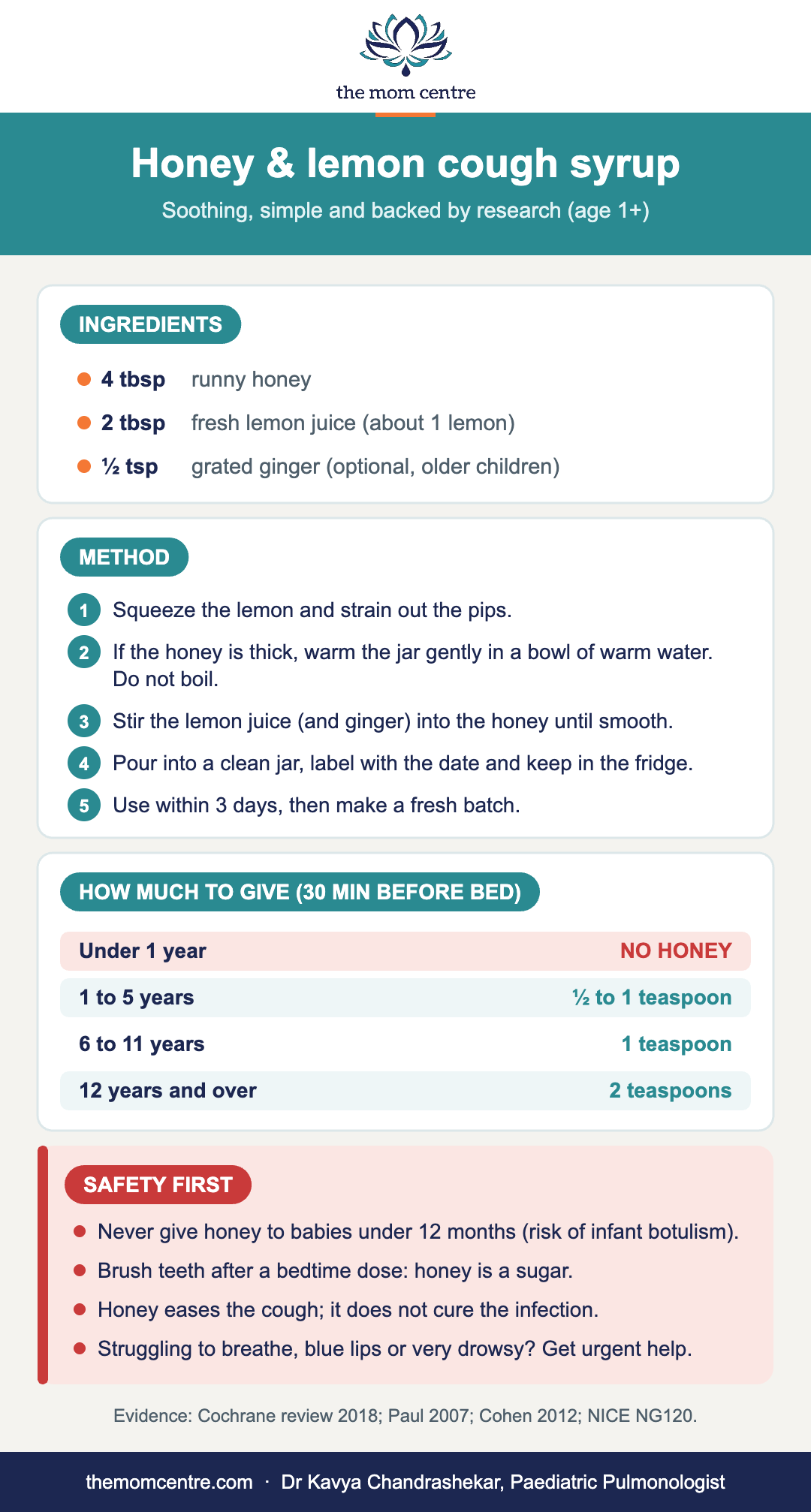
Ingredients (makes about 6 tablespoons)
- 4 tablespoons runny honey
- 2 tablespoons freshly squeezed lemon juice (about 1 lemon)
- Optional, for older children and adults: ½ teaspoon finely grated fresh ginger, for extra warmth
Method
- Squeeze the lemon and strain out any pips.
- Warm the honey gently if it’s thick: stand the jar in a bowl of warm water for a few minutes. Don’t boil it.
- Stir the lemon juice (and ginger, if using) into the honey until smooth.
- Pour into a clean, dry jar with a lid and label it with the date.
- Store in the fridge and use within 3 days, then make a fresh batch.
How to give it
- Use the honey amounts in the table above as your guide (for example, 1 teaspoon of syrup for a 6 to 11-year-old), about 30 minutes before bed.
- Or make a warm honey and lemon drink: stir a dose into half a cup of warm water. Always check it isn’t too hot before giving it to your child.
- Brush your child’s teeth afterwards, or at least give a drink of water, as honey is a sugar.
Safety: what every parent should know
- Never give honey to babies under 12 months, including in homemade remedies, dummies or drinks. Honey can contain spores of the bacteria that cause infant botulism, a rare but serious illness.
- Look after teeth. Honey is a sugar, so brush teeth after a bedtime dose.
- Diabetes: if your child has diabetes, talk to their diabetes team before using honey regularly.
- Honey treats the symptom, not the infection. It won’t speed up recovery from a cold, and a cough after a cold can still last up to 3 weeks.
- Shop-bought “honey” cough syrups often contain other medicines. In the UK, over-the-counter cough and cold medicines are not recommended for children under 6. Always read the label.
- Any type of honey will do. Studies used buckwheat, eucalyptus, citrus and labiatae honey. There’s no good evidence that expensive honeys such as manuka work better for cough.
Honey is not a substitute for medical care. Get urgent help if your child is struggling to breathe, has blue or grey lips, is very drowsy, or is a baby under 3 months with a fever. For a full list of warning signs, read our guide Child’s cough: when to worry.
Frequently asked questions
Is honey better than cough medicine for children?
In studies, honey worked at least as well as dextromethorphan, a common ingredient in cough syrups, and better than the antihistamine diphenhydramine. Because over-the-counter cough medicines are not recommended for young children in the UK, honey is often a better first choice for children over 1.
Can I give honey to my 10-month-old baby?
No. Honey should not be given to babies under 12 months in any form, because of the risk of infant botulism. For babies, offer extra feeds and use saline nose drops to ease a blocked nose.
Does warm water destroy the benefits of honey?
There’s no evidence that warm water stops honey from easing a cough. Use warm rather than very hot water, mainly so the drink is safe for your child.
How many times a day can I give honey for cough?
Most studies used a single dose at bedtime. Giving a dose during the day as well is reasonable for a short-term cough, but keep an eye on your child’s total sugar intake and look after their teeth.
Does honey and lemon work for adults too?
Yes. The 2020 Oxford review included adults and found honey helped with cough and cold symptoms. Adults can take about 2 teaspoons per dose.
The bottom line
For children over 1 year old, a spoonful of honey before bed is a safe, simple and evidence-based way to ease a cough and help everyone sleep. Lemon makes it taste great, and the homemade syrup above is a lovely way to give it. Just remember: never for babies under 12 months, brush teeth afterwards, and always seek help if your child seems seriously unwell.
References
- Oduwole O, Udoh EE, Oyo-Ita A, Meremikwu MM. Honey for acute cough in children. Cochrane Database of Systematic Reviews 2018, Issue 4. CD007094.
- Paul IM, Beiler J, McMonagle A, et al. Effect of honey, dextromethorphan, and no treatment on nocturnal cough and sleep quality for coughing children and their parents. Arch Pediatr Adolesc Med. 2007;161(12):1140-6.
- Cohen HA, Rozen J, Kristal H, et al. Effect of honey on nocturnal cough and sleep quality: a double-blind, randomized, placebo-controlled study. Pediatrics. 2012;130(3):465-71.
- Abuelgasim H, Albury C, Lee J. Effectiveness of honey for symptomatic relief in upper respiratory tract infections: a systematic review and meta-analysis. BMJ Evidence-Based Medicine. 2021;26(2):57-64.
- National Institute for Health and Care Excellence. Cough (acute): antimicrobial prescribing (NG120). 2019.
This article is for general information and does not replace advice from your own doctor. If you are worried about your child, contact your doctor or local emergency services.