
Written by Dr Kavya Chandrashekar, paediatric pulmonologist (children’s lung specialist). Last reviewed: November 2026.
Most childhood fevers are caused by viruses and get better on their own in 3 to 5 days. Your job isn’t to chase the number down to 37°C. It’s to keep your child comfortable, drinking, and watched.
First, check your child has none of the warning signs in When to worry about your child’s fever. If they’re in the green zone, here’s how to care for them at home.
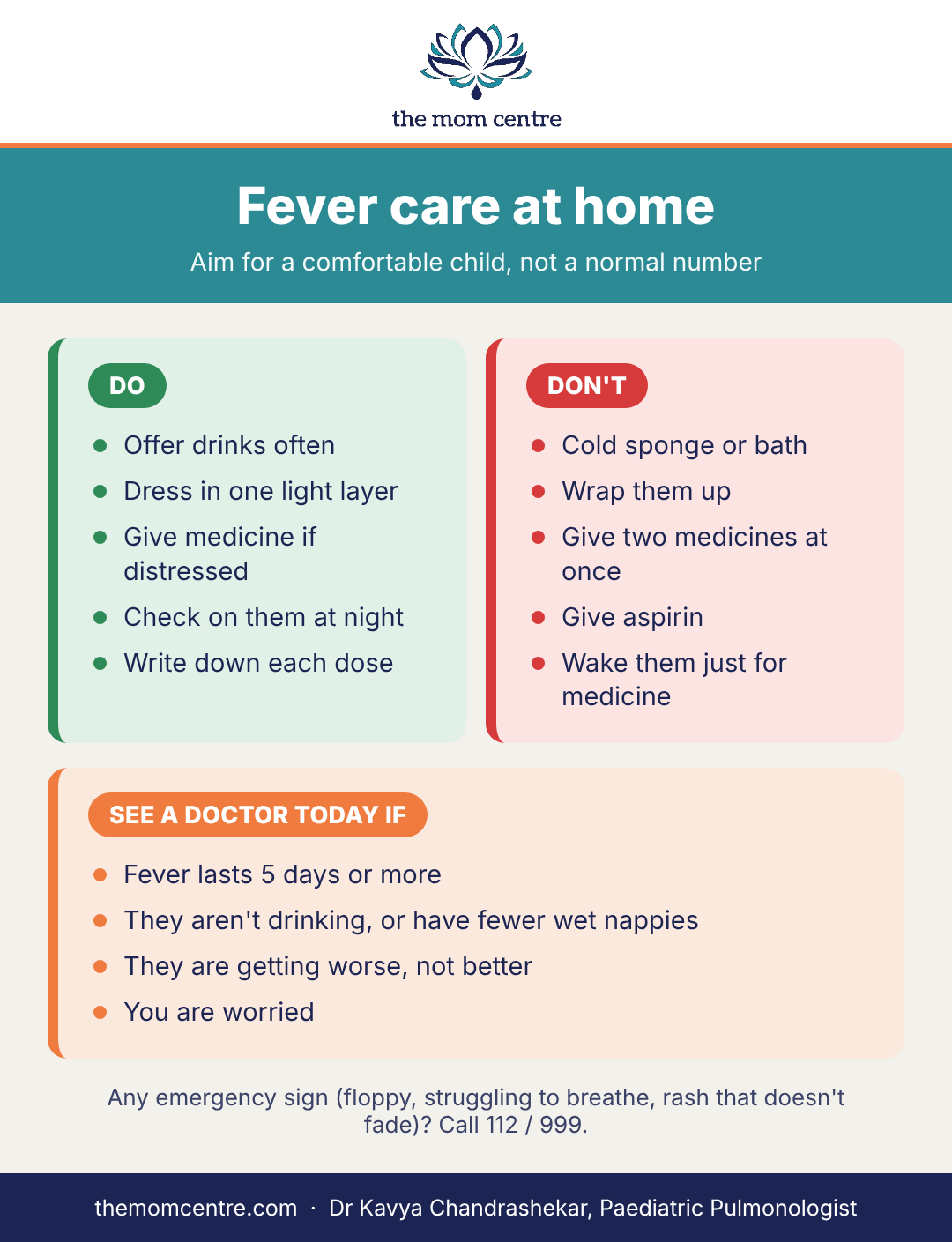
1. Give plenty of fluids
Fever makes children lose water faster. Offer small, frequent drinks: breast milk or formula for babies, water or diluted juice for older children. Food matters less for a day or two.
Signs of dehydration: a dry mouth, no tears, sunken eyes, a sunken soft spot in babies, or far fewer wet nappies. If you see these, call your doctor.
2. Dress them lightly
One light layer and a sheet is enough. Don’t wrap them up, and don’t strip them bare either. Keep the room comfortably cool, not cold.
3. Use fever medicine for comfort, not for the number
Give paracetamol or ibuprofen if your child is distressed or uncomfortable. A happy, playing child with a temperature of 38.5°C doesn’t need medicine.
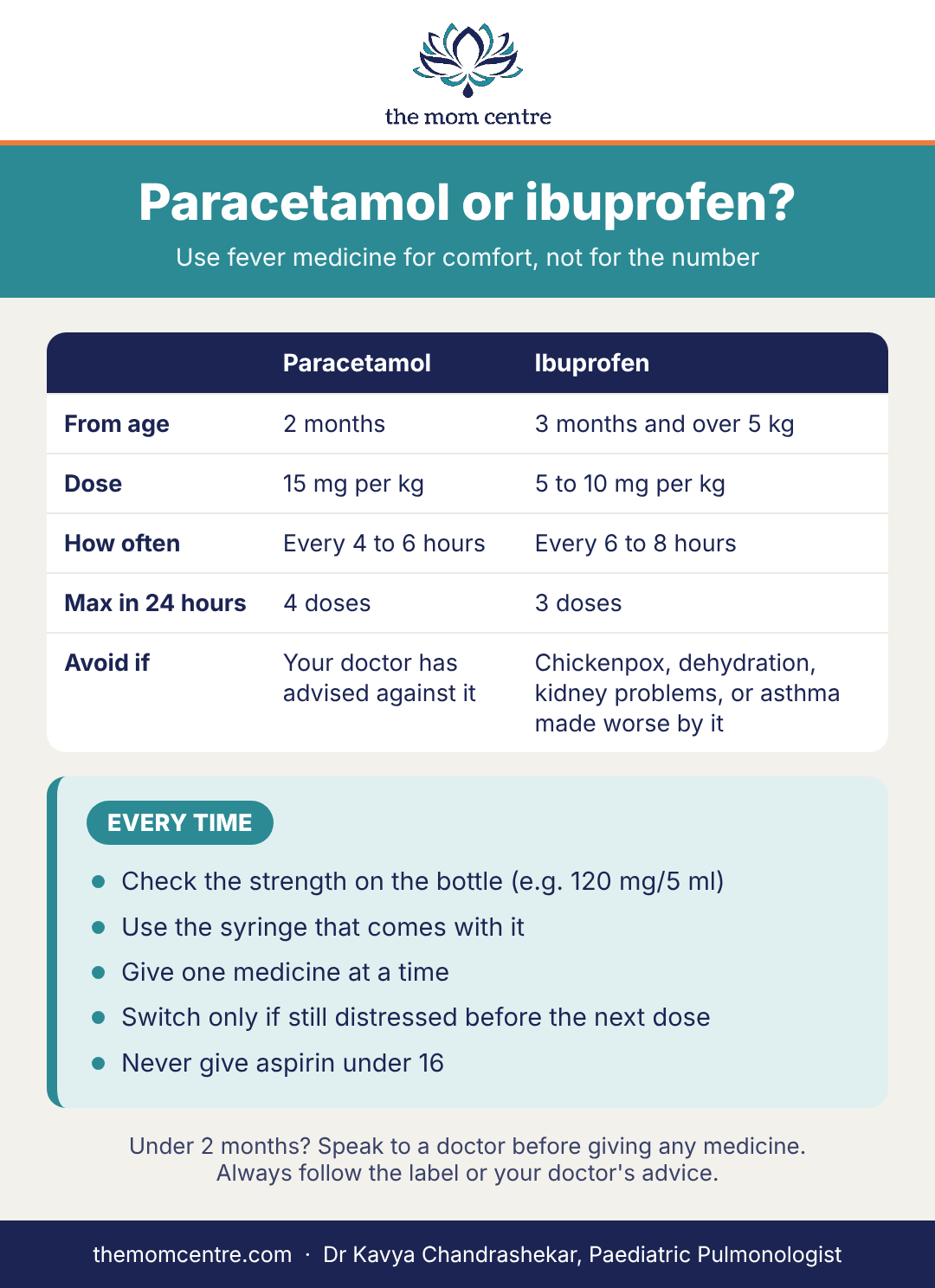
| Paracetamol | Ibuprofen | |
|---|---|---|
| From what age | 2 months (under 2 months only if a doctor advises) | 3 months and over 5 kg |
| Usual dose | 15 mg per kg of body weight | 5 to 10 mg per kg of body weight |
| How often | Every 4 to 6 hours | Every 6 to 8 hours |
| Maximum | 4 doses in 24 hours | 3 doses in 24 hours |
| Avoid if | A doctor has advised against it | Chickenpox, dehydration, kidney problems, or asthma that ibuprofen has made worse before |
Always:
- Check the strength on the bottle (for example 120 mg/5 ml or 250 mg/5 ml). Different strengths need different amounts.
- Use the syringe or spoon that comes with the medicine, never a kitchen spoon.
- Write down the time of each dose, especially if more than one person is caring for your child.
- Never give aspirin to a child under 16.
Example: a 10 kg toddler needs about 150 mg of paracetamol, which is about 6 ml of a 120 mg/5 ml syrup. Always follow the label or your doctor’s advice for your child.
Should I alternate paracetamol and ibuprofen?
Start with one medicine, and don’t give both at the same time. Only consider switching to the other if your child is still distressed before the next dose is due. Alternating doubles the chance of dosing mistakes, so keep a written log.
4. Keep watching, including at night
Check on your child regularly, including during the night. Keep them home from nursery or school while they have a fever.
7 fever myths I hear every week
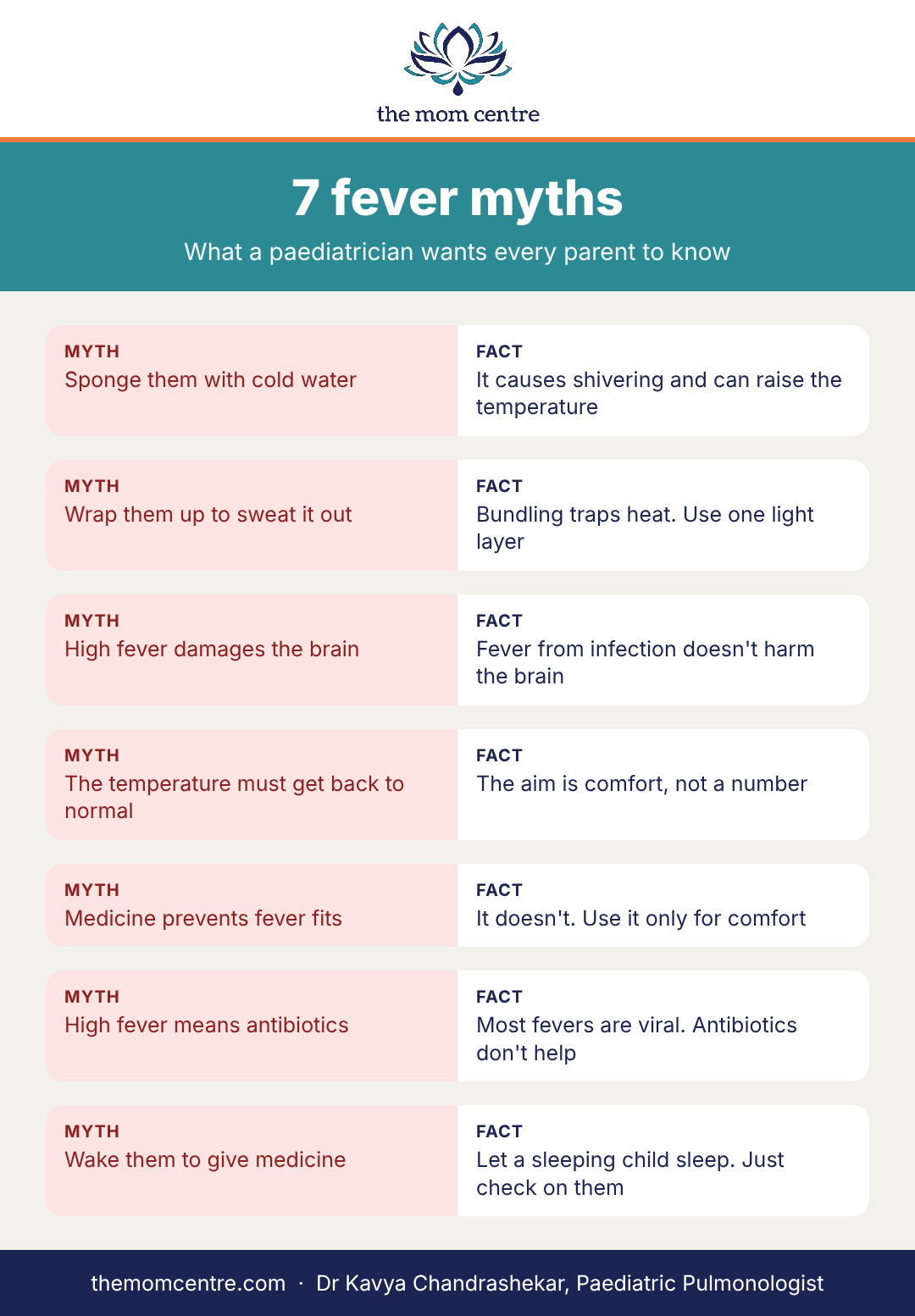
Myth 1: “Sponge them with cold water.” Cold or tepid sponging makes the skin vessels tighten and causes shivering, which can actually raise the core temperature. It’s also miserable for your child.
Myth 2: “Wrap them up to sweat it out.” Bundling traps heat and can push the temperature higher.
Myth 3: “A high fever will damage their brain.” Fever from infection does not cause brain damage.
Myth 4: “The temperature must come down to normal.” The aim is comfort. A fever that only drops from 39.5°C to 38.5°C but leaves your child playing is a success.
Myth 5: “Fever medicine prevents febrile fits.” It doesn’t. See Febrile seizures: what to do.
Myth 6: “A high fever means they need antibiotics.” Most high fevers are viral, and antibiotics don’t work on viruses. Your doctor decides after examining your child.
Myth 7: “Wake them up to give the medicine.” If your child is sleeping peacefully, let them sleep. Sleep helps recovery. Just check on them.
When to get help
Call your doctor (or NHS 111 in the UK) if the fever lasts 5 days or more, your child is getting worse, isn’t drinking, or you’re worried. Call 112 (India) / 999 (UK) for any emergency sign, such as a rash that doesn’t fade under a glass, trouble breathing, or a floppy, drowsy child.
Frequently asked questions
How can I bring my child’s fever down fast?
Give paracetamol or ibuprofen at the right dose for their weight, offer fluids and dress them lightly. Medicine usually starts working within 30 to 60 minutes.
Can I give paracetamol and ibuprofen together?
Not at the same time. If your child is still distressed before the next dose is due, you can consider giving the other medicine. Keep a written record of every dose.
How long does a viral fever last in children?
Usually 3 to 5 days. Contact your doctor if it lasts 5 days or more.
Should I give a cold bath for fever?
No. Cold baths and sponging cause shivering and don’t help. Light clothing and fluids are better.
Does fever medicine treat the infection?
No. It only makes your child more comfortable while their body fights the infection.
Read next: When to worry about your child’s fever · Febrile seizures: what to do
Sources
This article is for general information and does not replace advice from your own doctor. If you are worried about your child, contact your doctor or local emergency services.