
Written by Dr Kavya Chandrashekar, paediatric pulmonologist (children’s lung specialist). Last reviewed: November 2026.
It’s 2 am. Your little one feels like a hot-water bottle, the thermometer says 39.4°C, and you’re wondering whether to wait for morning or go to hospital now.
I’ve had this conversation with thousands of parents, and here’s what I tell every one of them: how your child looks and behaves matters far more than the number on the thermometer.
This guide uses the same traffic-light system doctors use (from NICE, the UK body that sets medical guidelines). It helps you decide in minutes whether to care for your child at home, call your doctor, or get emergency help.
What counts as a fever?
A fever in a child is a temperature of 38°C (100.4°F) or higher.
Fever itself is not an illness. It’s the body’s normal, healthy response to infection, usually a virus such as a cold, flu or a tummy bug. Most fevers settle on their own within 3 to 5 days.
The one exception: young babies
For young babies, the number does matter:
- Under 3 months with 38°C or higher: get medical help urgently, even if your baby seems well.
- 3 to 6 months with 39°C or higher: speak to a doctor the same day.
Young babies can’t show us they’re seriously unwell the way older children can, so we always check them.
The fever traffic light
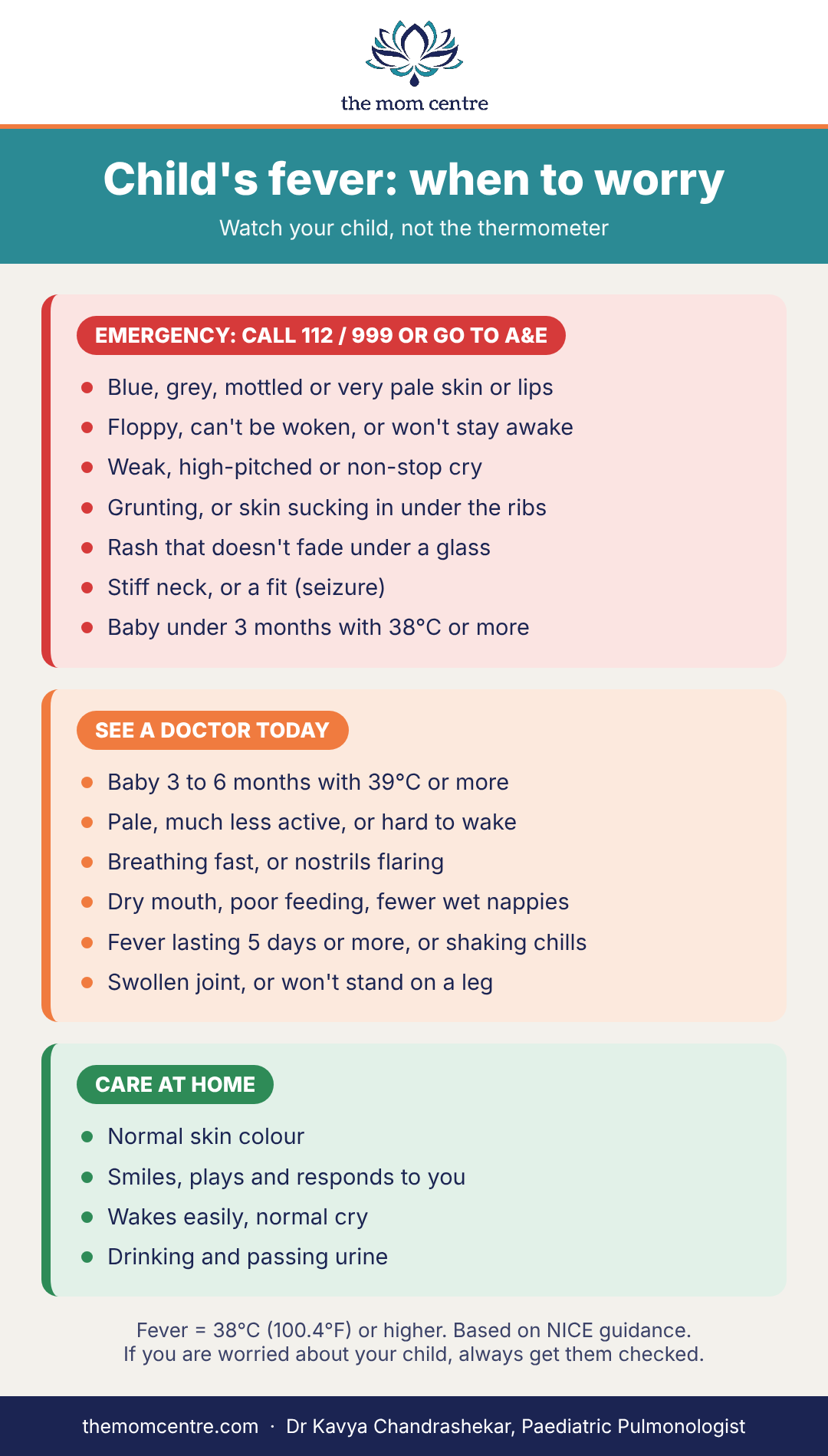
Green: low risk, care for your child at home
- Normal skin, lip and tongue colour
- Responds to you normally, smiles or plays (even briefly once a fever medicine has worked)
- Stays awake, or wakes easily
- A strong, normal cry, or not crying
- Moist lips and mouth, and still passing urine
What to do: care for them at home (see How to bring down your child’s fever at home) and check on them, including through the night.
Amber: see a doctor today
- Pale skin that you notice yourself
- Not responding normally, not smiling, or only waking with a lot of effort
- Much less active than usual
- Breathing fast, or nostrils flaring
- Dry mouth, poor feeding (babies), or far fewer wet nappies
- A fever lasting 5 days or more
- Shaking chills (rigors)
- A swollen limb or joint, or not putting weight on a leg
- Age 3 to 6 months with a temperature of 39°C or higher
What to do: call your GP or paediatrician (or NHS 111 in the UK) the same day.
Red: emergency – call 112 (India) / 999 (UK) or go to A&E now
- Pale, mottled, ashen or blue skin, lips or tongue
- Floppy, can’t be woken, or won’t stay awake
- A weak, high-pitched or non-stop cry
- Grunting, very fast breathing, or the skin sucking in under the ribs
- A rash that doesn’t fade when you press a glass on it
- A stiff neck, or a bulging soft spot on a baby’s head
- A fit (seizure)
- Age under 3 months with a temperature of 38°C or higher
The glass test for rashes
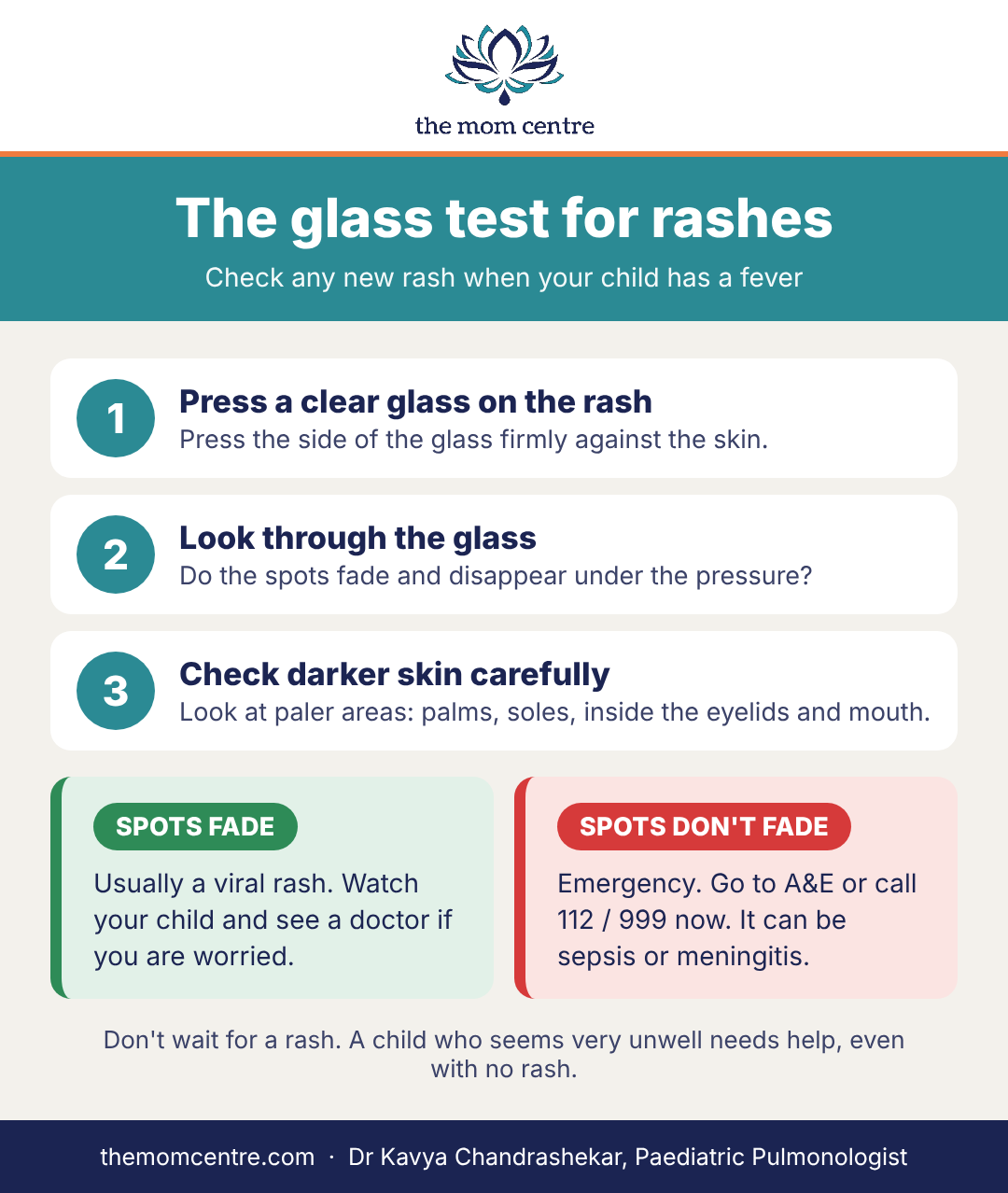
Press the side of a clear glass firmly against the rash. If you can still see the spots through the glass, the rash is “non-blanching”. With a fever, this can be a sign of sepsis or meningitis. Go to hospital straight away. On darker skin, check paler areas such as the palms, soles and inside the eyelids.
“But the fever is so high!”
This is the worry I hear most. A temperature of 40°C sounds frightening, but in a child over 6 months the height of the fever doesn’t tell us how serious the infection is. A child at 40°C who is running around after a dose of paracetamol is often less worrying than a child at 38.5°C who is floppy and pale.
Watch the child, not the thermometer.
How to take your child’s temperature
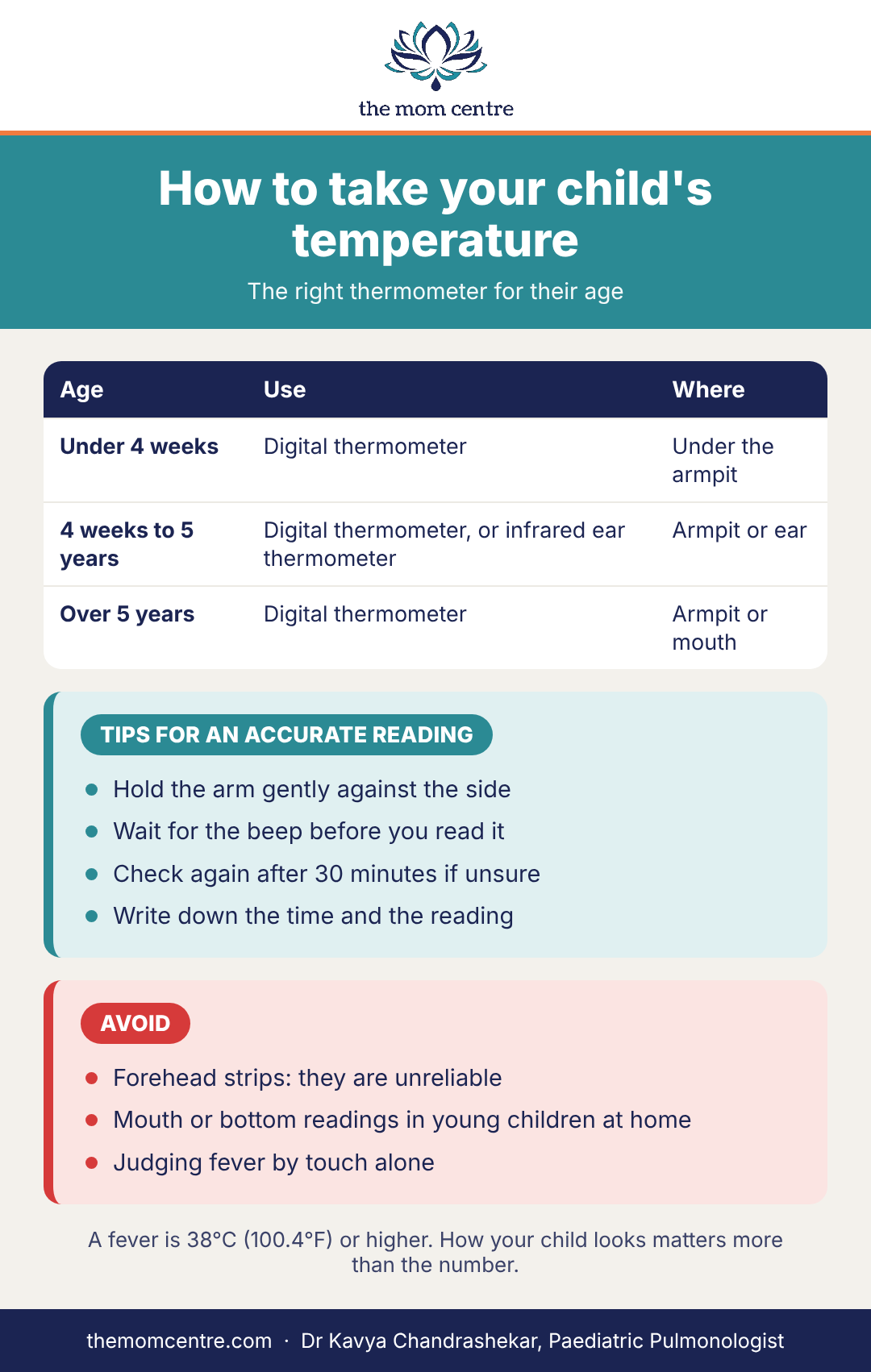
- Under 4 weeks: a digital thermometer under the armpit.
- 4 weeks to 5 years: a digital thermometer under the armpit, or an infrared ear thermometer.
- Avoid forehead strips, which are unreliable, and don’t take readings in the mouth or bottom of a young child at home.
Fever with a cough? See also Child’s cough: when to worry.
Trust your instinct
You know your child better than anyone. If something feels wrong, even if nothing on this list fits, get your child checked. As a paediatrician, I would always rather see a well child than miss an unwell one.
Frequently asked questions
What temperature is too high for a child?
Any temperature of 38°C or more in a baby under 3 months needs urgent medical care. In older children there’s no single danger number. Look for the amber and red warning signs instead.
When should I take my child to A&E for a fever?
Go straight away if your child has any red sign: blue or mottled skin, floppiness, trouble breathing, a rash that doesn’t fade under a glass, a stiff neck, or a fit.
How many days of fever is too long?
Contact your doctor if a fever lasts 5 days or more, even if your child seems well.
Can teething cause a high fever?
Teething can cause a slightly raised temperature but not a true fever of 38°C or more. Don’t put a fever down to teething.
Is a fever dangerous for my child’s brain?
No. Fever from an infection doesn’t damage the brain. What matters is finding the cause of the fever.
Read next: How to bring down your child’s fever at home · Febrile seizures: what to do
Sources
This article is for general information and does not replace advice from your own doctor. If you are worried about your child, contact your doctor or local emergency services.