
Written by Dr Kavya Chandrashekar, paediatric pulmonologist (children’s lung specialist). Last reviewed: November 2026.
Your toddler went to bed with a sniffle. A few hours later you’re woken by a sound you’ve never heard before: a harsh, barking cough, like a seal. Your child is upset, their voice is hoarse, and there may be a squeaky, rasping noise every time they breathe in.
That is croup, and it’s one of the scariest things a parent can hear at night. As a children’s chest specialist, I see it every winter. Most children with croup get better within a couple of days, but it helps enormously to know what to do in the moment, and which signs mean you need help fast.
Quick answer
Croup is a viral infection that makes the voice box and windpipe swell, causing a barking cough, a hoarse voice and sometimes a noisy breath in (stridor). It mostly affects children aged 6 months to 3 years and is worst at night.
Keep your child calm and upright, and contact your doctor: a single dose of a steroid medicine eases the swelling within a few hours. Call 999 (UK) or 112 (India) if your child is struggling to breathe, has blue or grey lips, or is very drowsy or agitated.
What is croup?
Croup is caused by common cold viruses, most often parainfluenza. The virus makes the area around the voice box (larynx) and windpipe (trachea) swell. A young child’s windpipe is narrow, so even a little swelling makes a big difference to the airflow. That’s what makes the cough sound like a bark, and the breath in sound harsh.
- Who gets it: mostly children aged 6 months to 3 years. It is less common after 6.
- When: autumn and winter, often starting suddenly at night.
- How it starts: usually a cold for a day or two, then the barking cough.
- How long it lasts: the first 1 to 2 nights are usually the worst. Most children are much better within 2 days, though the cough can linger for up to a week.
The 3 signs of croup
- A barking cough, like a seal or a dog.
- A hoarse, croaky voice or cry.
- Stridor: a high-pitched, harsh or squeaky sound when your child breathes in. It is often loudest when they’re upset or crying.
Many children also have a mild fever and a runny nose.
How serious is it? The croup traffic light
The most important check is this: listen to your child’s breathing when they are calm, not crying. Stridor only when upset is common in mild croup. Stridor when calm and settled means more swelling.
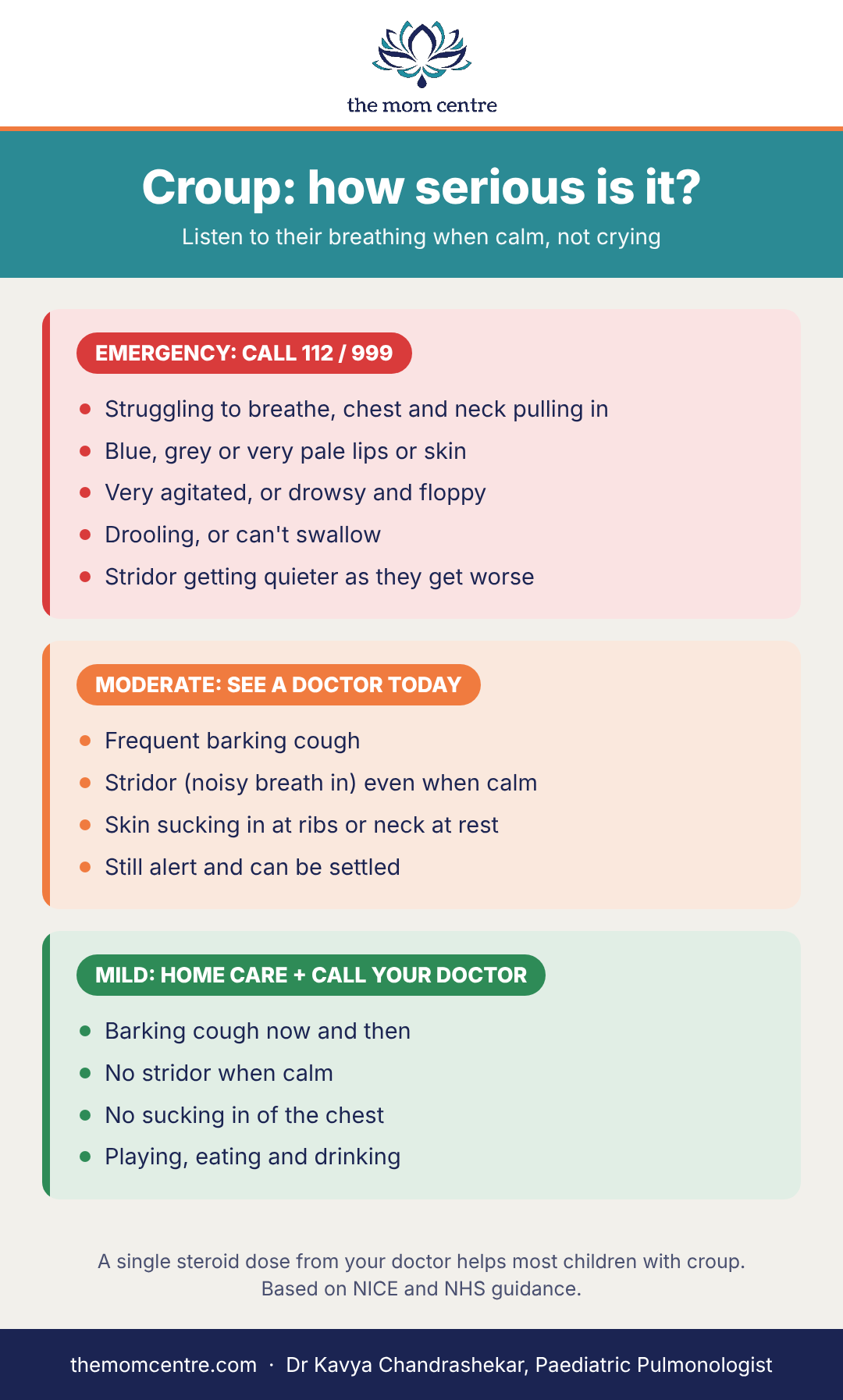
Mild: care at home, and call your doctor
- barking cough now and then
- no stridor when calm
- no sucking in of the skin between the ribs or at the neck
- still playing, eating and drinking
Call your GP, NHS 111 or your paediatrician during the day. Current UK guidance is that most children with croup, even mild croup, benefit from a single dose of steroid medicine.
Moderate: see a doctor today
- frequent barking cough
- stridor even when your child is calm
- skin sucking in between the ribs or at the base of the neck while resting
- but your child is still alert, and can be settled
Severe: emergency, call 999 (UK) or 112 (India)
- struggling to breathe, with the chest and neck pulling in hard
- blue, grey or very pale lips or skin
- very agitated and restless, or unusually drowsy and floppy
- drooling, or unable to swallow
- stridor getting quieter while your child seems to be getting worse. This can mean they are tiring, and is an emergency
What to do when your child has croup at night
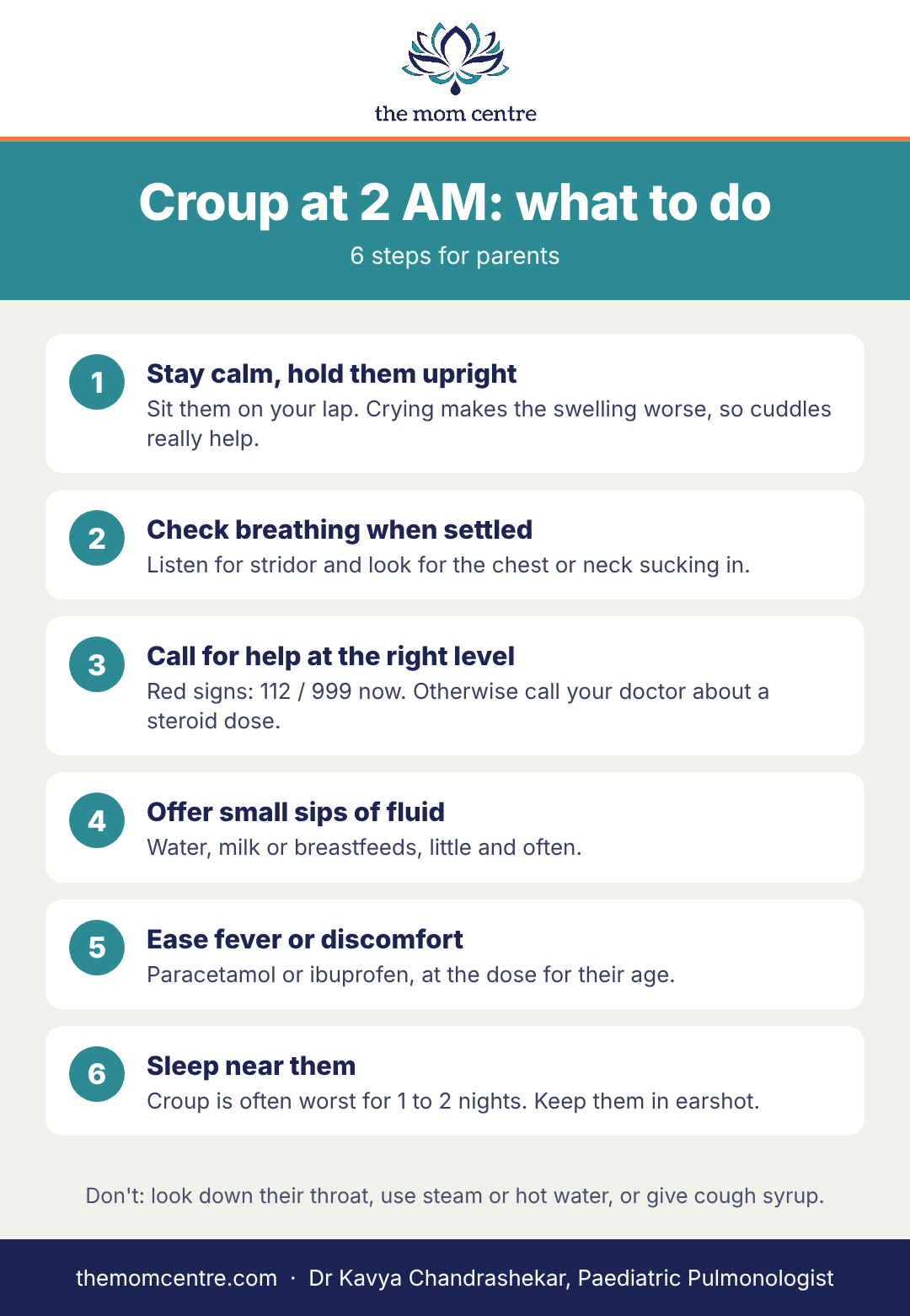
- Stay calm and hold them upright. Sit your child on your lap, facing you or leaning on your chest. Crying makes the swelling and stridor worse, so comfort, cuddles and a favourite toy or video genuinely help their breathing.
- Check their breathing when they’re settled. Listen for stridor and look at their chest and neck for sucking in. Use the traffic light above.
- Call for help at the right level. Red signs: 999 or 112 straight away. Amber signs: a doctor today. Green: call your GP, NHS 111 or paediatrician to ask about a steroid dose.
- Offer drinks. Small, frequent sips of water or milk. Breastfeeding is fine.
- Ease the fever or discomfort. Paracetamol or ibuprofen can make your child more comfortable. They don’t treat the swelling.
- Sleep near them. Croup is usually worse for 1 to 2 nights. Keep your child in your room or sleep in theirs so you can hear their breathing.
Please don’t look down their throat with a spoon or your finger, put them in a steamy bathroom or near hot water, or give cough syrup. None of these help, and some can make things worse.
How do doctors treat croup?
- A single dose of steroid medicine, usually dexamethasone, by mouth. It reduces the swelling, starts working within a few hours, and means fewer children need hospital care. One dose is very safe.
- In hospital, for severe croup, children may get oxygen and an adrenaline nebuliser, which shrinks the swelling within minutes. They are watched for a few hours afterwards because the effect wears off.
- Antibiotics don’t help, because croup is caused by a virus.
Croup myths and facts
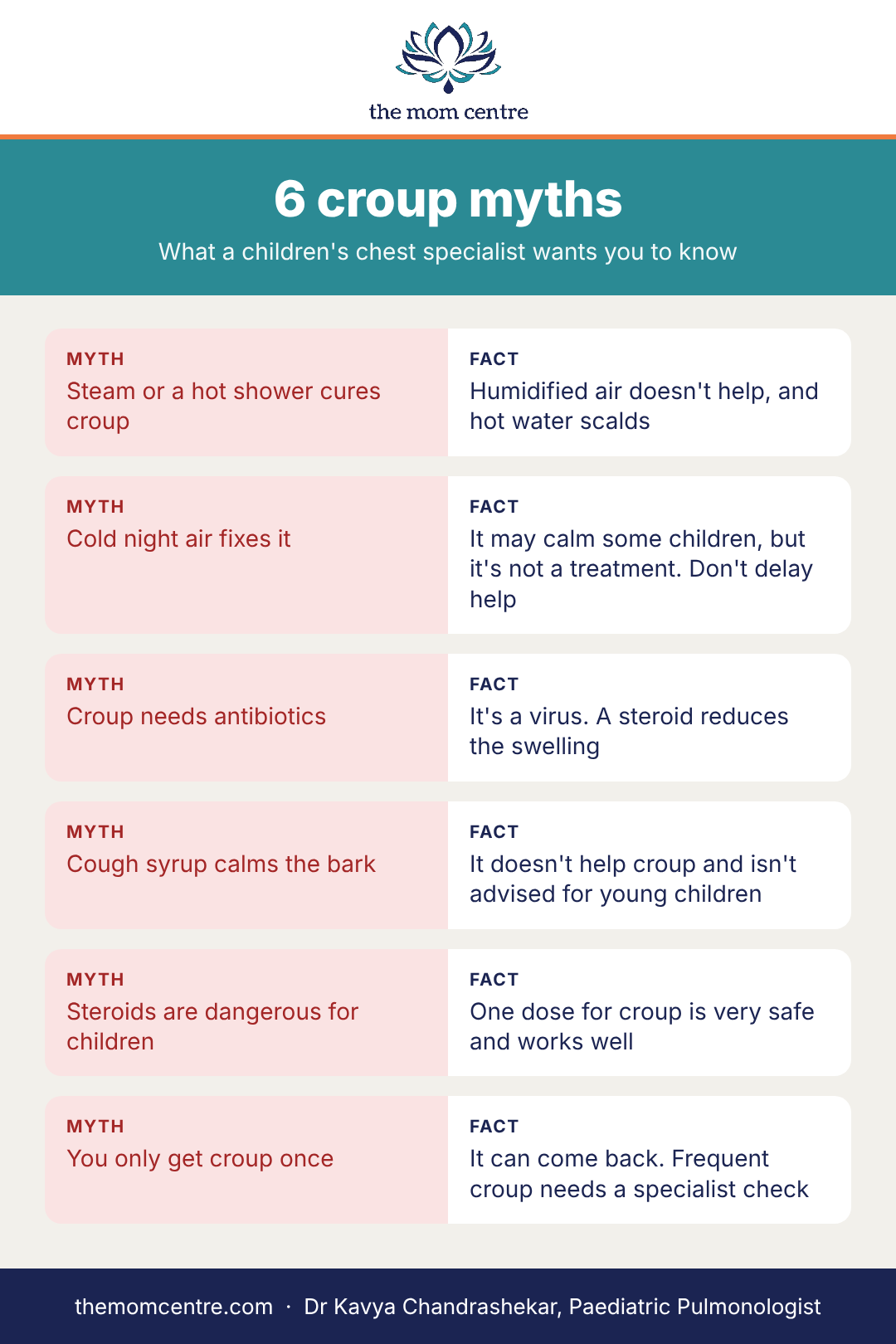
- Myth: steam or a hot shower cures croup. Fact: studies found that humidified air doesn’t help, and hot water scalds many children every year.
- Myth: cold night air will fix it. Fact: some parents find a few minutes by an open window calms their child, but there’s no proof it treats croup. Never let it delay getting help.
- Myth: croup needs antibiotics. Fact: it’s a virus. A steroid is what reduces the swelling.
- Myth: cough syrup will calm the bark. Fact: cough medicines don’t help croup and aren’t recommended for young children.
- Myth: steroids are dangerous for children. Fact: one dose for croup is very safe and works well.
- Myth: you can only get croup once. Fact: children can get it several times. Frequent croup needs a specialist check.
Is it croup, or something else?
A few rarer conditions can look like croup and need urgent help:
- Epiglottitis: high fever, looking very unwell, drooling, can’t swallow, sitting forward to breathe, and usually no barking cough. It’s now rare thanks to the Hib vaccine, but it’s an emergency.
- An inhaled object: sudden coughing or noisy breathing after choking on food or a small toy, with no cold beforehand.
- A severe allergic reaction: sudden swelling of the lips, face or tongue, a rash, or breathing difficulty after eating something new.
When croup keeps coming back
Most children have croup once or twice. In my clinic I’d like to see a child if they have:
- croup more than twice in a year
- croup before 6 months of age
- noisy breathing or a hoarse voice between episodes
- croup that is severe or needs hospital care each time
Repeated croup can be linked to asthma, reflux or, rarely, a narrowing in the airway. A paediatric respiratory specialist can check for these.
Frequently asked questions
What does croup sound like?
A loud, barking cough like a seal, a hoarse voice, and often a harsh, squeaky noise when breathing in (stridor). It usually starts suddenly at night after a day or two of cold symptoms.
Why is croup worse at night?
The body’s natural steroid levels are lowest at night, so the airway swelling is greater. Lying down and crying when woken also make the noisy breathing worse.
How long does croup last?
The first 1 to 2 nights are usually the worst. Most children are much better within 2 days, but the cough can last up to a week. If your child isn’t improving after 3 days, see a doctor.
Is croup contagious?
Yes. The virus spreads like a cold, through coughs, sneezes and hands. Older children and adults usually just get a cold. Your child can go back to nursery or school once they feel well and have no fever.
Should I take my child to hospital for croup?
Go to A&E or call 999 (UK) or 112 (India) if your child is struggling to breathe, has noisy breathing when calm that’s getting worse, is blue or grey, very drowsy or agitated, or can’t swallow. For milder croup, call your doctor for a steroid dose.
Does steam help croup?
No. Research shows humidified air doesn’t improve croup, and hot steam can cause serious burns. Keeping your child calm and upright helps more.
Can adults get croup?
Rarely. The same viruses usually just cause a cold or sore throat in adults, because their windpipe is wider.
The bottom line
Croup sounds frightening, but most children recover within a couple of days. Keep your child calm and upright, listen to their breathing when they’re settled, and call your doctor, because a single steroid dose really helps. Know the red signs, and never hesitate to call 999 or 112 if your child is struggling to breathe.
Read next: Child coughing at night? · Child’s cough: when to worry · Child’s fever: when to worry · How to bring down your child’s fever at home
Sources
- NICE Clinical Knowledge Summaries: Croup
- NHS: Croup
- NICE NG120: Cough (acute): antimicrobial prescribing
This article is for general information and does not replace advice from your own doctor. If you are worried about your child, contact your doctor or local emergency services.